
Teachers Across The United States Go On A Hunger Strike For Palestinian Children In Gaza
Educators call on U.S. policymakers to protect children in Gaza by ensuring a free flow of food and humanitarian aid enters Gaza, and recognize the rights Palestinians have under international law.

Publisher’s note: Inadvertent aims to collaborate with more local journalists to bring more coverage to underreported local issues.
This article first appeared on the author’s Substack. It has been republished here with permission. Subscribe to Abraham Márquez to receive more of his work.
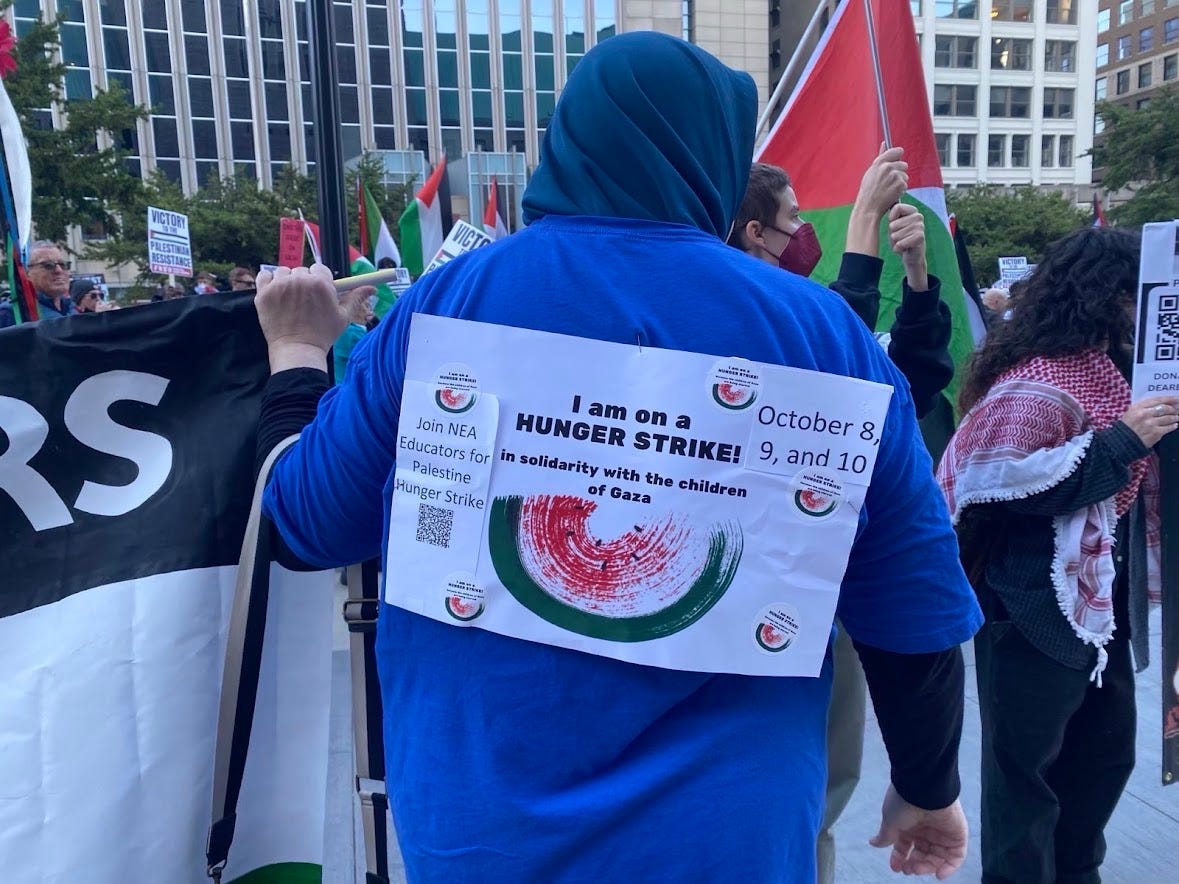
Around the world, teachers are often regarded as mentors, movement builders, guides, and community organizers. When they extend their lessons beyond the classroom, applying theory into practice, their actions serve as powerful tools and symbols of conscience.
On October 8th, marking the second anniversary of Israel’s attack on Palestinians in Gaza, more than one hundred K-12 educators from across the United States began a three-day hunger strike to raise awareness about the severe situation facing Palestinian children in the Israeli-occupied Gaza Strip. Teachers are calling on policymakers to act now to protect the rights of Palestinian children.
“I joined the hunger strike because we must protest the United States’ complicity in the genocide and starvation of children in Gaza. On a personal note, I lost a younger cousin this past weekend as well, but the immense pain I feel is only a fraction of the pain that the people in Gaza have been enduring for the past two years. Too many young children, mothers, fathers, and innocents have been senselessly massacred,” said Mike Rodriguez, a public school educator from Orange County (OC).
Over the past two years, educators across the country have employed various forms of protest to raise awareness about the Palestinian cause. There is no single, verified total for teachers fired due to their support for Palestine, but reports from across the nation mention professors being dismissed for showing support.
Internationally recognized humanitarian organizations have documented the inhumane treatment Palestinians face since October 2023. The United Nations International Children’s Emergency Fund (UNICEF) reported in December 2023 that “The Gaza Strip is the most dangerous place in the world to be a child. And day after day, that brutal reality is reinforced.”
The United Nations Office for Coordination of Humanitarian Affairs (OCHA) Secretary General, Mr. Tom Fletcher, stated on September 24th:
“To try to find words to convey the horror, and to fail again to do it justice. To repeat that something must be done. And, I fear, to accept that nothing will.
Knowing that our words will not reach Mariam (who was killed a month ago), the children under the bombs, those scraping through the rubble for food, enduring amputations without anesthetic, losing their last sparks of hope.
Fearing that not a single word today will reach and resonate those who could stop this 21st century atrocity.”
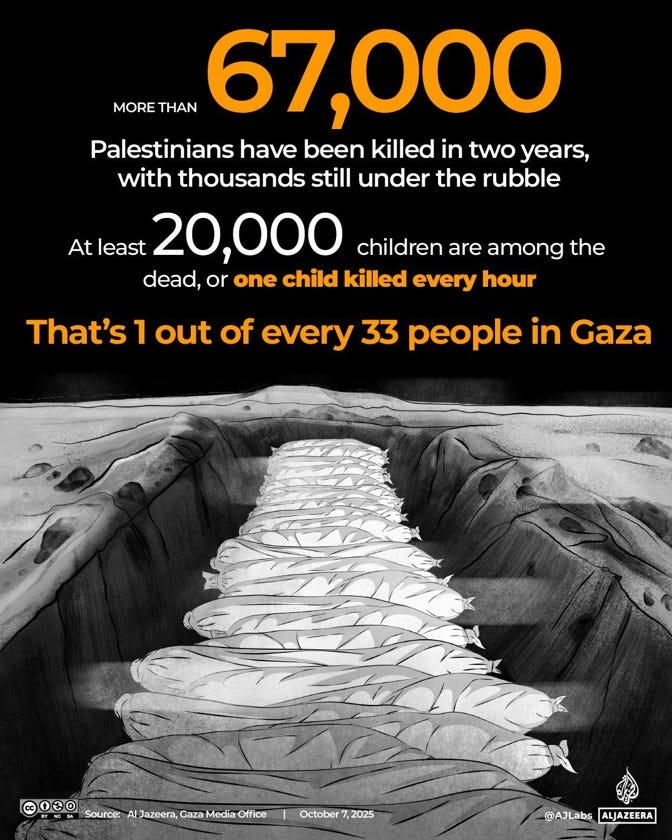
Since October 2023, over 67,000 Palestinians have been killed by Israeli attacks. Thousands more are under the rubble. “At least 20,000 children are among the dead, or one child killed every hour for the past 24 months,” according to a recent Al Jazeera article.
The effects of Israel’s bombing campaign on the Gaza Strip are compounded by the 16-year siege, during which Israel maintains a stranglehold, restricting the amount of food, aid, and materials that can enter the enclave.
Teachers dedicate their lives to nurturing others, yet they are now risking their own health for three days to call attention to the suffering of people beyond their classrooms, the Palestinian children in the Gaza Strip. Their hunger strike becomes both an act of solidarity and a moral lesson for the world.
“The Integrated Food Security Phase Classification (IPC) and the World Health Organization (WHO) both published a report stating that there is famine in Gaza,” said Erika Gomez, an educator from Los Angeles. “Over half a million people will face catastrophic levels of starvation, and many will die without anyone hearing about it because Israel has killed almost all the journalists in Gaza.”
This hunger strike demonstrates that education doesn’t stop when the school bell rings, it carries on in the streets and public spaces.
“I’ve never gone three days without eating. It feels like a long time. But after those three days, I’ll be able to eat again, and the people in Gaza won’t be able to,” said Colin, a middle school teacher in Massachusetts. “Experientially, it’s very personal, but doing this as a group offers a portal into a more universal struggle.”
In their press release, they state that each participant will decide the length and intensity of their action.
This nationwide hunger strike is one of many that have occurred since October 2023 to raise awareness about the humanitarian crisis in Gaza. College students across Los Angeles and nationwide have adopted this form of protest to stop the genocide and pressure their universities to divest from companies complicit in Israel’s genocide.
“I am joining in on the hunger strike with teachers across the U.S. to bring attention to the mass starvation of the people in Gaza, and especially the children,” said Linn Lee, a retired public school educator from the O.C.
The hunger strike, organized by Educators for Palestine, a caucus within the National Education Association (NEA), follows the group’s recent push to have the nation’s largest labor union sever ties with the Anti-Defamation League (ADL). Many K–12 educators involved in the effort argue that the ADL functions as a pro-Israel political advocacy group rather than a social justice partner for schools. NEA delegates voted to end the union’s collaboration with the ADL, but the decision was later overturned by NEA leadership following pressure from the ADL.
“In addition to the work I’ve done through the union, I have been contacting legislators, standing out at protests, and donating money,” said Theresa, a middle school nurse in Minnesota. “This hunger strike is kind of upping it to the next level. We are putting our own bodies in harm’s way. A hunger strike is a more active way to participate and use my body to show resistance and solidarity.”
The strikers hope that their message reaches the people of Gaza, and that they know people are thinking about them daily. Their message is clear: education must be paired with action, and compassion must move us to do the right thing.
 | A guest post by
|