
Fusion Center Ran Flock Searches on Behalf of Feds, Santa Ana Records Show
State law prohibits ALPR data sharing with federal and out-of-state agencies.

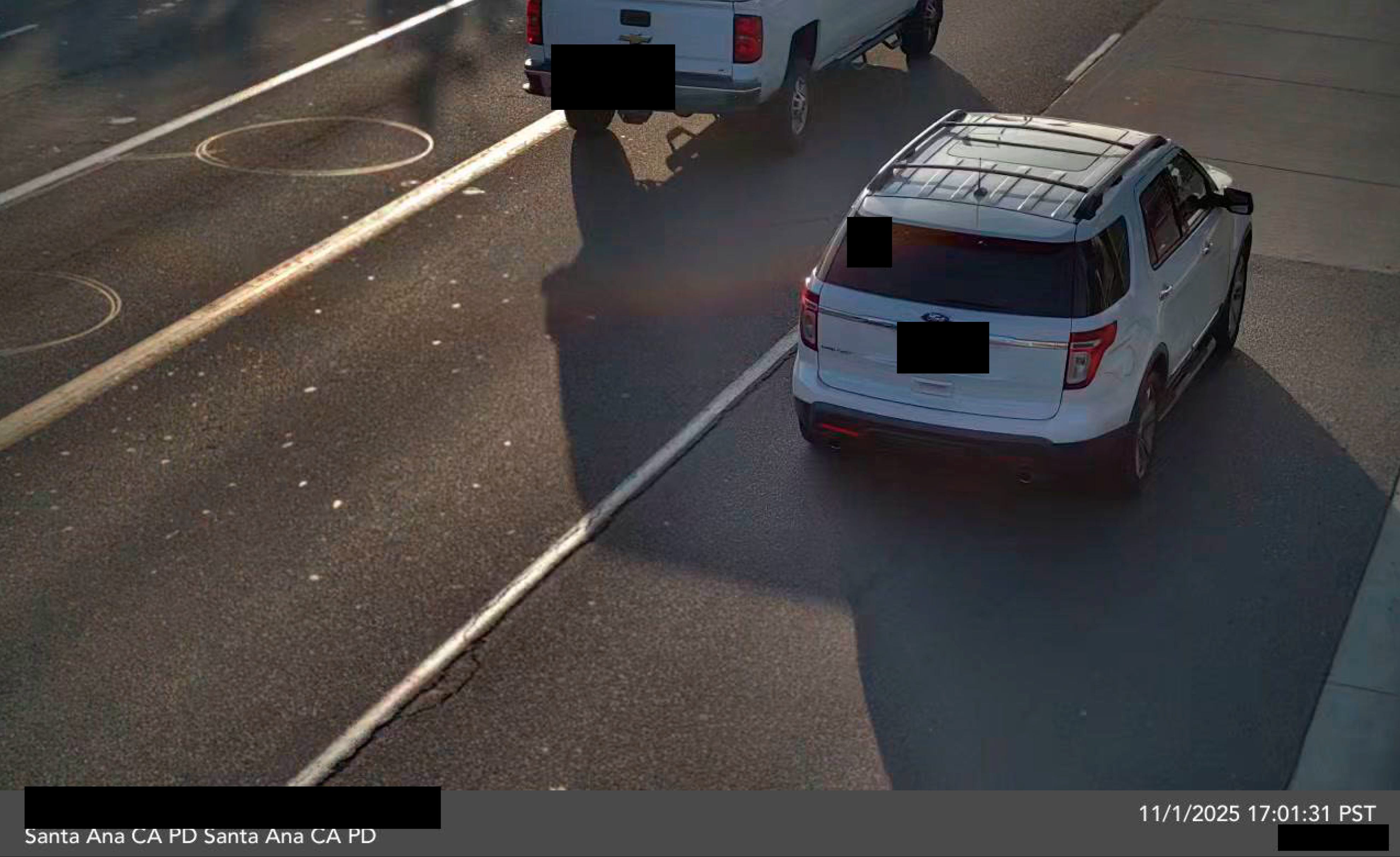
SANTA ANA - The Northern California Regional Intelligence Center (NCRIC), a secretive intelligence hub called a fusion center, ran searches of Santa Ana’s Flock automated license plate reader (ALPR) system on behalf of multiple federal and out-of-state agencies — the two types of agencies that California law prohibits sharing data with — records released to Inadvertent show. The records are logs of outside agencies’ queries performed within the Flock ALPR system, including those conducted by the fusion center. The logs show at least seven federal agencies listed in the reasons for searches. In the span of six months, NCRIC conducted over 27,000 searches that accessed Santa Ana’s network. Three other searches were run on behalf of Orange County’s fusion center, the Orange County Intelligence Assessment Center (OCIAC).
The records show that NCRIC ran at least eighty searches for the Department of Justice and other agencies underneath it including the Federal Bureau of Investigation; the Bureau of Alcohol, Tobacco, Firearms and Explosives; the United States Marshals Service; and the Drug Enforcement Administration. The United States Forest Service (USFS), the Internal Revenue Service (IRS), and an agency in Clark County, Washington also appear in the records.
Guidance from the state attorney general requires agencies to maintain records about how their ALPR data is used after being accessed and to assure its use is compliant with the agencies’ privacy policy.
Fusion centers are black-box-style intelligence centers that share data between federal, state, local, and tribal agencies, as well as the private sector; they make up a national network of intelligence sharing hubs, overseen by the Department of Homeland Security (DHS), and are funded by federal, state, and local dollars.
The log was released by the city in May after Inadvertent submitted a public records request two months prior.
Santa Ana Police Department (SAPD) spokesperson Natalie Garcia stated, “NCRIC is a California state entity and is subject to all applicable state laws and oversight requirements.”
She did not respond to further questions about the specific federal and out-of-state agencies’ searches in the city’s records or about the city’s responsibility to ensure data sharing practices are compliant even after data is accessed by an outside agency.
City Attorney Sonia Carvalho and city spokesperson Paul Eakins did not answer questions about whether these data sharing practices are compliant with the law and SAPD’s ALPR policy.
Councilmember Ben Vazquez stated, “I stand firmly against the use of Flock cameras and mass surveillance technology in Santa Ana. Residents deserve privacy, not a network that can be quietly tapped by federal or out-of-state agencies.”
He added that he would call for an audit of the department’s ALPR usage through the police oversight commission and expected to see “proof.”
Mayor Valerie Amezcua and councilmembers Thai Viet Phan, Jessie Lopez, Phil Bacerra, Johnathan Hernandez, and David Penaloza did not respond to repeated requests for comment.
The records released by SAPD offer a window into how agencies are using the massive Flock ALPR networks, including Santa Ana’s, after residents traveling around the city are scanned, recorded, and put into a database, all without consent or a warrant. Santa Ana officials previously claimed they could not access their own data in Flock’s system. NCRIC’s searches represent about two and a half percent of the activity that passed through SAPD’s network between June 2025 and March 2026. The bulk of the queries, around 1 million, belong to other state and local agencies.
State law requires an agency that gives other agencies access to its ALPR data to log every search, including the username of the person who ran it, their agency, and the reason for running the search. The records released by SAPD do not show usernames, only agency names. It’s unclear if this information was redacted or simply does not exist. Separately, SAPD’s ALPR policy, dated January 5, 2026, requires a case number or incident number related to the query. This information is not present either in the record released, but it’s unclear if queries performed before the policy’s latest version required this information to be logged.
Flock and other ALPR systems are a form of mass surveillance, indiscriminately recording and tracking residents regardless of their behavior. NCRIC and OCIAC are part of DHS’ nationwide network of surveillance centers established after the September 11, 2001 attacks. According to the city of Santa Ana’s public documents portal and a public records request by Inadvertent, there is no memorandum of understanding (MOU) between the city and NCRIC. The city’s MOU with OCIAC is listed.
In June this year, the San Francisco Police Department said it cut off the NCRIC’s access to their Flock network after the department discovered that NCRIC had run hundreds of searches on behalf of federal and out-of-state agencies.
“When this contract was approved, council members justified the expansion of surveillance by promising accountability and measurable public safety outcomes, yet failed to deliver on their one-year public audit,” said Tanya Navarro, Chispa’s Organizing Director. “This shows that the same elected officials who voted to approve this contract are unwilling to conduct meaningful oversight. Which follows a pattern across the country where oversight and guardrails are promised but either not put into place or fail to address the concerns raised.”
She added, “This is because the problems with this type of surveillance cannot be remedied by oversight. The privacy violations and potential for misuse of the data are inherent features of these systems, which are designed to enrich private companies above all else.”
The records were released over a year after the Santa Ana city council voted to enter into the ALPR contracts with Flock Safety and Motorola Solutions. At that meeting, officials also voted to direct staff to bring back a one-year “efficacy” update. That update is nonexistent. Previous reporting showed that almost zero percent of a week’s scans of residents resulted in a connection to a criminal investigation.
This week, communities across the country are participating in the National Week of Action Against ALPRs. Thousands of Americans are calling for an end to ALPR surveillance, and Orange County is a hub for this activism. Events, including in Santa Ana, are slated throughout the week.